

Effluent Treatment Plant (ETP): Process, Types, Design and Cost in India


Effluent Treatment Plant (ETP)
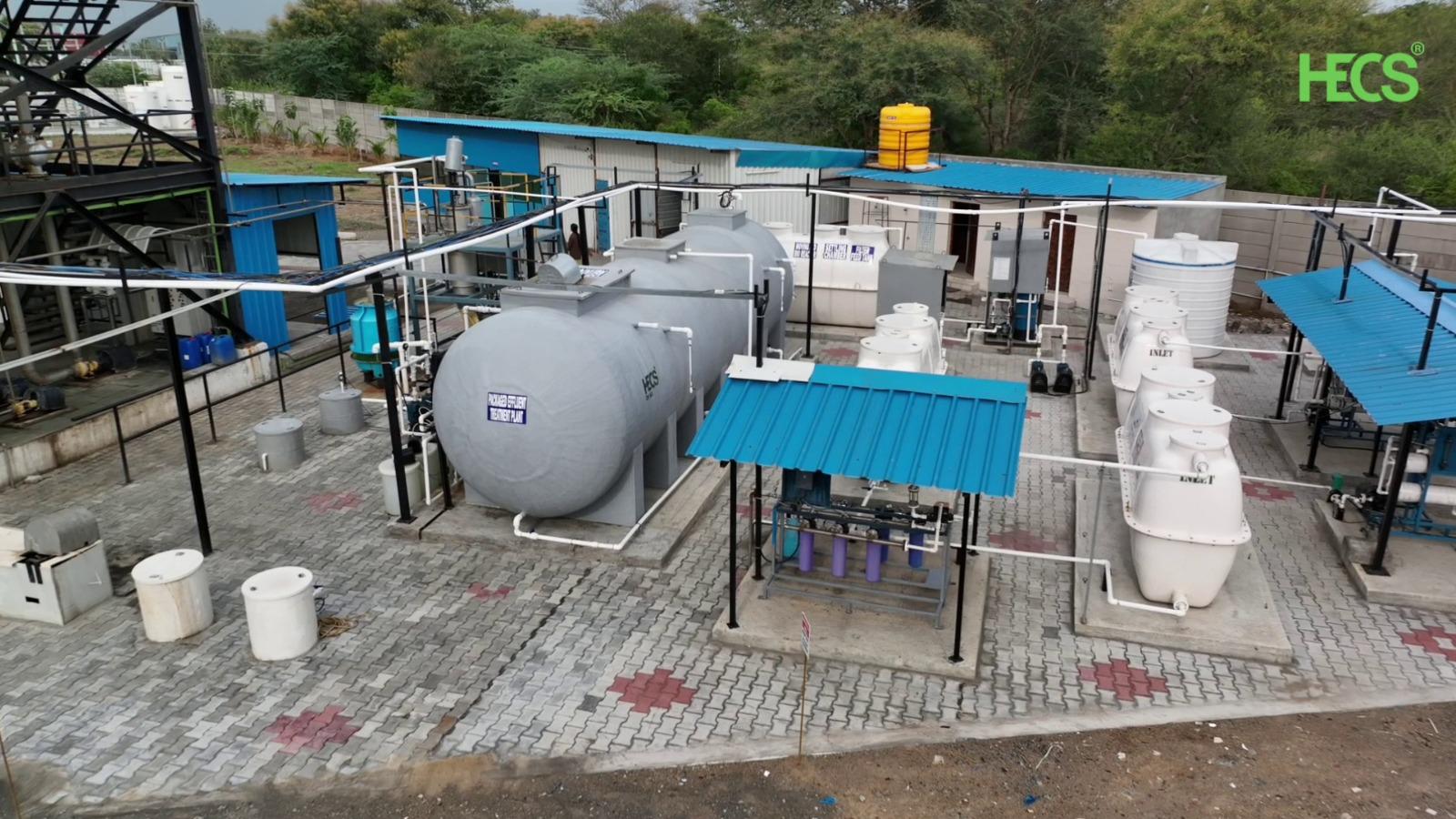
An effluent treatment plant (ETP) treats industrial wastewater so it can be safely discharged, sent to a common treatment facility or reused. It removes pollutants such as suspended solids, organic load (BOD and COD), oil, colour, toxic chemicals and heavy metals, using physical, chemical and biological processes.
In India, most units that generate process wastewater need an ETP to meet the consent conditions issued by their State Pollution Control Board (SPCB). Textile, pharmaceutical, chemical, food, dairy, automobile and engineering units are typical examples.
There is no standard ETP. The right plant depends on what is in your wastewater, how much you produce and when, and whether you will discharge or reuse it.
Key takeaways
• An ETP is designed around your effluent's test results, not a catalogue model.
• Conventional ETPs remove solids and organics but not dissolved salts (TDS). That needs RO or evaporation.
• Size the plant from measured effluent flow and peaks, not total water consumption.
• Segregating strong or toxic streams is often cheaper than building a bigger plant.
• Your SPCB consent order, not a generic "CPCB norm", sets the standard your ETP must meet.
What Is an Effluent Treatment Plant?
An effluent treatment plant (ETP) is an engineered system that treats wastewater from industrial processes. It removes solids, organic matter, chemicals and other pollutants so the treated water meets the discharge or reuse standards that apply to that facility.
Effluent is the liquid waste that leaves a process. Examples include dye-bath wash water, reactor-cleaning water from a pharma plant, whey from a dairy or rinse water from a plating line. Unlike sewage, its composition changes by industry, and often from batch to batch in the same plant.
An ETP does three jobs:
1. Separates oil, grit, suspended solids and precipitated metals.
2. Breaks down biodegradable organics using microorganisms, and some resistant compounds using chemical oxidation.
3. Polishes the remaining water through filtration and, where required, membranes or evaporation.
It produces two outputs, treated water and sludge, and both must be managed under your consent and the waste rules.
Why Do Industries Need an ETP?
• Permission to operate. Under the Water Act, 1974, a discharging unit needs SPCB consent, and its conditions set what the ETP must achieve.
• Environmental protection. Untreated effluent depletes oxygen in water bodies and can contaminate groundwater and soil for years.
• Water savings and lower risk. Reuse cuts freshwater costs, and a well-run ETP avoids regulatory action and failed customer audits. A sudden COD rise also flags product being lost to the drain.
How Does an Effluent Treatment Plant Work?
An ETP passes wastewater through a sequence of treatment steps. Each step targets a particular type of pollutant. The steps are grouped into preliminary, primary, secondary and tertiary treatment, plus sludge handling.
Not every ETP needs every step. An engineering unit may need only oil removal, chemical treatment and filtration. A bulk-drug plant may need all of them, plus advanced oxidation and evaporation.
1. Preliminary treatment
• Collection and segregation. Keep strong, toxic or high-salt streams apart from dilute wash water and domestic sewage.
• Screening, oil and grit removal (as needed). Protect pumps and downstream units.
• Equalisation. A mixed holding tank that evens out flow and strength across shifts and batches. It is often the most important tank in a batch plant.
• pH correction. Brings pH into the range the next stages need.
2. Primary (physico-chemical) treatment
• Coagulation and flocculation. Chemicals such as alum, ferric chloride or poly-aluminium chloride, followed by a polymer, gather fine particles into larger flocs.
• Clarification or flotation. Flocs settle in a clarifier, or float off in a dissolved air flotation (DAF) unit when they are light or oily.
• Metal removal. Most dissolved metals are precipitated by adjusting pH, and each metal has its own optimum range.
Hexavalent chromium must first be chemically reduced. Metals bound to complexing agents (such as EDTA or ammonia) may need extra treatment.
3. Secondary (biological) treatment
• Biological reactor. Bacteria consume biodegradable organics, using activated sludge, MBBR, SBR, MBR or anaerobic reactors.
• Secondary clarifier. Settles the biomass. Part is returned to the reactor and the excess goes to sludge handling.
For biodegradable effluent, biology is usually the most economical way to reduce organic load. It struggles with toxic compounds and shock loads.
4. Tertiary and advanced treatment (as required)
• Filtration. Sand filters remove residual solids. Activated carbon reduces residual organics, colour and odour.
• Advanced treatment. UF, reverse osmosis (RO), ion exchange, advanced oxidation or evaporation, for reuse, TDS reduction, persistent compounds or ZLD.
• Disinfection. Chlorine, UV or ozone, where the consent requires it or reused water may contact people.
5. Sludge handling and final use
• Dewatering. A filter press, screw press or centrifuge converts wet sludge into a cake for storage and authorised disposal (see ETP sludge).
• Discharge or reuse. Treated water is discharged as per consent, sent to a CETP, or reused.
ETP Process Flow Diagram
Collection → Screening → Oil/grit removal* → Equalisation → pH correction → Coagulation–flocculation → Clarifier or DAF* → Biological treatment → Secondary clarifier → Sand filter → Carbon filter* → Disinfection* → Discharge or reuse
Sludge line: Primary and biological sludge → Thickener* → Dewatering → Covered storage → Authorised disposal
*Included only when the effluent or the treatment objective requires it.
Does an ETP remove TDS?A conventional one does not. Salts pass through biological and chemical treatment, and neutralisation chemicals can add more. If TDS is in your consent or reuse target, the design needs RO, ion exchange or evaporation. |
Treatment objective | Typical additions to the base train |
Discharge within consent limits | Base train, sized to your consent |
Reuse (cooling, washing, gardening) | + UF and/or RO, + disinfection |
Zero liquid discharge (ZLD) | + RO, + evaporator (e.g. MEE), + crystalliser or agitated thin-film dryer (ATFD) |
What Pollutants Does an ETP Remove?
An ETP removes the pollutants it is designed to remove. That is why wastewater testing comes first.
Parameter | What it indicates | Typical removal route |
TSS | Suspended particles | Screening, settling, DAF, filtration |
BOD | Biodegradable organic load | Biological treatment |
COD | Total chemically oxidisable load | Biology for the biodegradable fraction; oxidation, adsorption or membranes for the rest |
TDS | Dissolved salts | Not removed by conventional ETPs ; needs RO, ion exchange or evaporation |
Oil and grease | Free and emulsified oils, fats | Oil traps; DAF with chemical emulsion breaking |
Colour | Dyes, pigments | Coagulation, oxidation, adsorption, membranes |
Heavy metals | Chromium, nickel, zinc, copper, lead and others | pH-controlled precipitation (with Cr(VI) reduction first), ion exchange |
Nutrients | Ammonia, nitrate, phosphate | Biological nitrification–denitrification, chemical phosphorus removal |
Specific chemicals | Solvents, phenols, cyanide, drug residues | Segregation, targeted chemistry, stripping, advanced oxidation |
Pathogens | Microbial contamination | Disinfection, membranes |
ETP Types and Technologies
By method: physico-chemical ETPs suit metal-bearing and inorganic effluent; biological ETPs suit biodegradable effluent; combined plants (the most common) handle mixed streams. By construction: RCC plants suit large, long-term installations, while packaged ETPs suit small to medium flows and tight sites
Technology | What it does | Best used for | Key consideration |
Coagulation–flocculation | Gathers fine solids, colour and precipitated metals | Colloids, colour, metals | Select chemicals and doses by jar test |
DAF | Floats oil, fats and light solids with micro-bubbles | Dairy, food, automobile effluent | Emulsified oil needs chemical conditioning first |
Activated sludge (ASP) | Suspended-growth aerobic treatment | Moderate to high biodegradable load, space available | Sensitive to shock and toxic loads |
MBBR | Biofilm on moving plastic carriers | Compact plants, capacity upgrades | Media retention screens and aeration design |
SBR | Treatment and settling in one tank, in timed cycles | Variable flows, nutrient removal | Relies on dependable automation |
MBR | Biological treatment with membrane separation | High-quality, low-TSS water; RO pre-treatment; tight footprint | Does not remove TDS; fouling control and membrane replacement cost |
Anaerobic reactor | Degrades organics without oxygen, producing biogas | High-strength biodegradable effluent (food, dairy, distillery) | Usually needs aerobic polishing to meet discharge limits |
Ultrafiltration (UF) | Removes fine particles, colloids, bacteria | RO pre-treatment, reuse | Needs stable upstream quality |
Reverse osmosis (RO) | Removes most dissolved salts and dissolved contaminants | TDS reduction, reuse, ZLD | Produces a concentrated reject that must be managed |
Advanced oxidation (AOP) | Ozone, Fenton or UV-peroxide break down resistant organics | Non-biodegradable COD, colour | Chemical and energy intensive; best on segregated streams |
MEE | Multiple-effect evaporator concentrates RO reject or high-TDS streams using steam | ZLD | High energy use; condensate may need polishing before reuse |
Crystalliser / ATFD | Converts evaporator concentrate into solid salts or dry residue | Final ZLD stage | Residue needs authorised disposal |
Selection matters more than the list. RO behind unstable biology fouls quickly, and an MBR will not fix a plant upset by solvent dumps. The reliable order is test → segregate → treat → polish.
How to Select the Right ETP Process
Direct answer: choose the ETP process by working through your effluent data in a fixed order. Start with source and flow, then pollutant load and biodegradability, then the treatment objective and site constraints. Only then pick technologies. Skipping steps is how plants end up oversized, undersized or unable to meet one parameter.
Step | Question to answer | What it decides |
1. Wastewater source | Which processes generate effluent? Continuous or batch? | Segregation plan, number of treatment lines |
2. Flow | Average, peak-day and peak-hour flow? Shift pattern? | Equalisation volume, hydraulic sizing |
3. Wastewater analysis | Stream-wise results for pH, BOD, COD, TSS, TDS, oil, metals, temperature | Which pollutant groups need a treatment stage |
4. Pollutant load | Flow × concentration, in kg/day | Reactor size, oxygen demand, chemical consumption, sludge quantity |
5. Biodegradability | How much of the COD is biodegradable (BOD/COD ratio, confirmed by treatability tests)? | Biology alone, or oxidation/segregation needed |
6. Treatment objective | Discharge, CETP inlet, reuse or ZLD? | How far the treatment train extends |
7. Discharge or reuse standard | Which limits apply: consent order, CETP inlet norms, reuse application? | Outlet design targets and safety margin |
8. Space | Land available, height limits, room for expansion? | Conventional vs compact (MBBR, MBR, packaged) |
9. CAPEX and OPEX | Budget for construction and for daily running? | Automation level, technology trade-offs |
10. Technology selection | Which combination meets steps 1–9 at the lowest lifecycle cost and risk? | Final process flow diagram |
Data a designer needs: measured average and peak flow, stream-wise lab results, the production and shift pattern, details of existing treatment, and your consent conditions. A single grab sample rarely represents a batch process, so use flow-proportional composite samples tested by an accredited laboratory such as HECS's NABL-accredited lab.
Want a second opinion on a proposal?
HECS engineers design industrial ETP and ZLD systems across sectors.
ETP Capacity: How Much Do You Need?
Direct answer: ETP capacity should equal your measured process-effluent flow, with the equalisation and hydraulic units sized for peak flows and a planned margin for expansion. It is expressed in KLD (kilolitres per day, equal to m³/day) or MLD (1 MLD = 1,000 KLD).
Don't size from total water consumption. In an illustrative example, a unit buys 150 KLD of water. 20 KLD goes to domestic use (an STP load), 30 KLD is lost to evaporation and product, and 100 KLD is process effluent, 60 KLD of it arriving in one shift. The right basis is 100 KLD average, a measured peak-hour flow, and equalisation that absorbs the batch dumps.
How Much Does an ETP Cost in India?
Direct answer: ETP cost in India depends mainly on capacity, the pollutant profile of the effluent and the treatment standard required. Two 50 KLD plants can differ in cost several times over. An oily-rinse-water plant and a pharma plant designed for ZLD are different projects. A per-KLD figure found online cannot reflect this, so this guide explains how to estimate and compare cost instead.
What drives capital cost (CAPEX)
• Capacity and peak flow. Cost per KLD generally falls as capacity rises.
• Effluent complexity. High COD, oil, metals, colour or toxicity each add stages.
• Treatment objective. Cost rises from discharge, to reuse, to ZLD, with membranes and evaporators the largest additions.
• Construction and materials. RCC versus packaged units; corrosive or hot effluent needs FRP, stainless steel or lined tanks.
• Automation and sludge handling. Manual versus PLC/SCADA; dewatering equipment and storage.
• Site and scope. Space, soil, piping distances; supply-only, turnkey or turnkey with operation.
Budgetary estimate vs firm price. A budgetary estimate can be prepared from basic flow and test data, and is useful for internal approvals. A firm price needs a site visit, stream-wise analysis and an agreed design basis.
How to get comparable ETP quotations
1. Fix the design basis: measured flow, lab results and the written treatment objective.
2. Ask every ETP manufacturer to quote on that same basis.
3. Require a process flow diagram and mass balance with each offer.
4. Ask for separate cost heads: civil, mechanical, electrical, piping, automation, installation, commissioning and training.
5. Ask for the estimated operating cost alongside the capital cost.
6. Compare lifecycle cost, not purchase price.
Check the exclusions. Quotes often exclude civil works, power supply to the panel, commissioning water, trial chemicals, statutory approvals, sludge disposal and treated-water storage. The lowest offer often excludes the most.
ETP vs STP vs CETP
Direct answer: an ETP treats industrial process wastewater, whose pollutants vary by industry. An STP treats domestic sewage, which is mainly biodegradable and similar everywhere. Many factories need both.For sewage systems, see the sewage treatment plant guide.
| ETP | STP |
Source | Manufacturing, washing, cleaning, process discharges | Toilets, kitchens, bathrooms, canteens |
Pollutants | Varies widely: COD, colour, oil, metals, TDS, chemicals, extreme pH | Mainly biodegradable organics, solids, nutrients, pathogens |
Complexity | Low to very high, by industry | Moderate and predictable |
Typical process | Physico-chemical + biological + advanced, as required | Mainly biological, then filtration and disinfection |
Design basis | Stream-wise lab data and loads | Occupancy and typical per-capita loads, checked by testing |
Reuse | Process, cooling, washing; ZLD in some cases | Flushing, gardening, cooling, construction |
ETPs for Different Industries
Industry | Typical effluent challenge | Likely treatment approach |
Textile and dyeing | Colour, high COD and TDS, hot water | Cooling, equalisation, chemical + biological, UF/RO for reuse; ZLD in some clusters |
Pharma and bulk drugs | Batch variation, solvents, poorly biodegradable COD | Strict segregation, solvent stripping, biology, RO/evaporation for strong streams |
Food and beverage | High BOD, fats, seasonal swings | Screening, DAF, anaerobic with biogas, aerobic polishing |
Dairy | Milk solids, whey, fats, CIP pH swings | Fat removal, pH-controlled equalisation, biology; keep whey out of the ETP |
Chemicals | Product-specific acids, solvents, metals, refractory COD | Stream-wise segregation, precipitation, oxidation, biology where feasible |
Automobile and engineering | Emulsified oil, phosphating rinses, metals | Oil separation, emulsion breaking, precipitation, filtration, reuse in washing |
Tanneries | Salts, chromium, sulphides | Chrome segregation and recovery, physico-chemical + biological, often via CETP |
Hospitals | Sewage plus lab and laundry streams | Biology, filtration, disinfection; also Bio-Medical Waste Management Rules, 2016 ( hospital ETPs ) |
ETP Compliance in India
Direct answer: an ETP in India must meet the conditions in the unit's consent from its SPCB (or Pollution Control Committee in a Union Territory). Those conditions draw on the Water Act, 1974 and on standards under the Environment (Protection) Rules, 1986, and may be stricter than national standards. There is no single discharge limit that applies to every industry.
• Water Act, 1974. Section 25 requires SPCB consent, which is implemented as a Consent to Establish (CTE) and a Consent to Operate (CTO).
• Water (Amendment) Act, 2024. Replaces imprisonment for several violations with penalties of ₹10,000 to ₹15 lakh, with appeals to the NGT, and lets the Centre exempt categories of industrial plants from consent. It initially applied to Himachal Pradesh, Rajasthan and the Union Territories; other states can adopt it.
• Notifications. G.S.R. 703(E) (12 Nov 2024), amended by G.S.R. 511(E) (28 Jul 2025), exempts certain categories of industrial plants from consent. Confirm with your SPCB before relying on it.
• Environment (Protection) Rules, 1986 set industry-specific (Schedule I) and general (Schedule VI) discharge standards.
• CPCB directions require online continuous monitoring (OCEMS) for specified highly polluting industries.
Is ETP sludge hazardous?
Not automatically. Chemical sludge from treating wastewater of processes listed in Schedule I of the Hazardous and Other Wastes Rules, 2016 is listed as hazardous. Biological sludge from biodegradable effluent often is not, unless it exceeds the Rules' concentration limits. The SPCB decides the classification in your authorisation, and hazardous sludge must go to an authorised TSDF or approved co-processing.
This is not legal advice. HECS provides CTE and CTO consultancy.
When Do You Need RO or ZLD?
Treated effluent can be reused for cooling, washing, gardening or, after RO, process water, if its quality suits the use and your consent allows it.
• RO is needed when your consent limits TDS below what the plant achieves, when reuse needs low-salt water, or when you are aiming for ZLD.
• ZLD is needed when a consent condition, direction or court order prohibits discharge, or when water scarcity justifies near-total recovery. It is not a blanket national requirement.
An ETP is not ZLD. ZLD builds on it: ETP → UF → RO → MEE → crystalliser or ATFD → solid residue, with the recovered water reused. See zero liquid discharge systems.
Common ETP Problems and When to Upgrade
Problem | Likely causes | Checks and corrective action |
High outlet COD | Non-biodegradable COD, toxic inflow, overload | Test each stream; segregate problem streams; add oxidation or carbon polishing |
High outlet BOD | Low DO, low biomass, overload, low temperature | Check DO, MLSS and F/M; restore aeration; improve equalisation |
Poor settling or bulking | Filamentous growth from low DO, low F/M, nutrient deficiency, septic feed | SVI and microscopy; correct DO and nutrients; adjust sludge age |
Foaming | Surfactants, fats, filamentous organisms, start-up (young) sludge | Source control; adjust sludge age; antifoam only as a last resort |
Odour | Septic tanks, dead zones, stored sludge | Mix and aerate equalisation; remove sludge regularly |
pH swings | Batch acid/alkali dumps, small equalisation | Continuous pH logging; automated dosing; scheduled batch release |
Colour not removed | Dyes resistant to biology | Chemical colour removal, oxidation or adsorption |
High TDS | Process salts plus treatment chemicals | Reduce at source; RO or evaporation |
Membrane fouling | Poor pre-treatment, scaling, oil, biofouling | Improve upstream treatment; antiscalant; correct cleaning regime |
Rising chemical cost | Fixed manual dosing, wrong chemical | Jar tests; flow-proportional or automatic dosing |
Consider an ETP upgrade when problems persist after operational fixes, or when flow has grown, products have changed, your consent has tightened, or you want to reuse water. Start with a performance audit: stage-wise testing and a mass balance against the design. HECS provides ETP operation, maintenance and retrofit services.
How to Choose an ETP Manufacturer
Ask any ETP manufacturer or consultant:
• Is the design based on a lab analysis of your effluent, with a mass balance?
• Have they built plants for similar effluent and scale?
• Do they offer more than one technology?
• Are installation, commissioning and a performance trial included?
• What O&M, AMC and spares support follows?
• What are the power, chemical and sludge costs?
Red flags: a per-KLD price before any data is shared, a guarantee with no stated inlet conditions, or no mention of sludge.
HECS Effluent Treatment Plant Solutions
Hubert Enviro Care Systems (HECS) is a Chennai-based environmental engineering company, established in 1997. It offers ETP design and turnkey installation with UF, RO and evaporation for reuse and ZLD. Its range also includes packaged FRP ETPs from 1 to 1,000 KLD, O&M for 60+ water and wastewater plants, an NABL-accredited (ISO/IEC 17025:2017), MoEF&CC-recognised laboratory, and CTE/CTO consultancy.
Project evidence
• ONGC, Rajahmundry: 1 MLD ETP. Primary, secondary and tertiary treatment with an on-site lab for daily testing.
• HLL Biotech: 225 KLD ZLD ETP + 25 KLD STP. Treatment, recycling and reuse of industrial effluent with zero liquid discharge.
• Global Pharma Health Care, Chennai: 20 KLD PETP + 6 KLD PSTP. Separate effluent and sewage systems, with treated water reused for gardening.
Start Your ETP Assessment
1. Understand your effluent sources and objective using this guide.
2. Assess: gather your flow data, lab reports, consent conditions and any current problems. No test data yet? HECS's laboratory can analyse your effluent first.
3. Contact a HECS engineer for the right next step: testing, a site visit, a budgetary estimate or a detailed proposal.
Share this post: