
Zero Liquid Discharge (ZLD): How Advanced Effluent Treatment Plants Help Industries Achieve 100% Water Reuse

Water is No Longer Cheap — It’s a Risk
If you’re running a factory in Tamil Nadu or Gujarat, you’ve already felt the pressure. Borewells are drying up, tanker costs are rising, and getting approval to discharge wastewater is harder than ever.
Regulators are tightening norms. One failed inspection can stop operations overnight . This is why industries are moving beyond basic treatment and investing in a zero liquid discharge system. It’s no longer just about treating water—it’s about securing your operations against future risk.
What is Zero Liquid Discharge (ZLD)?
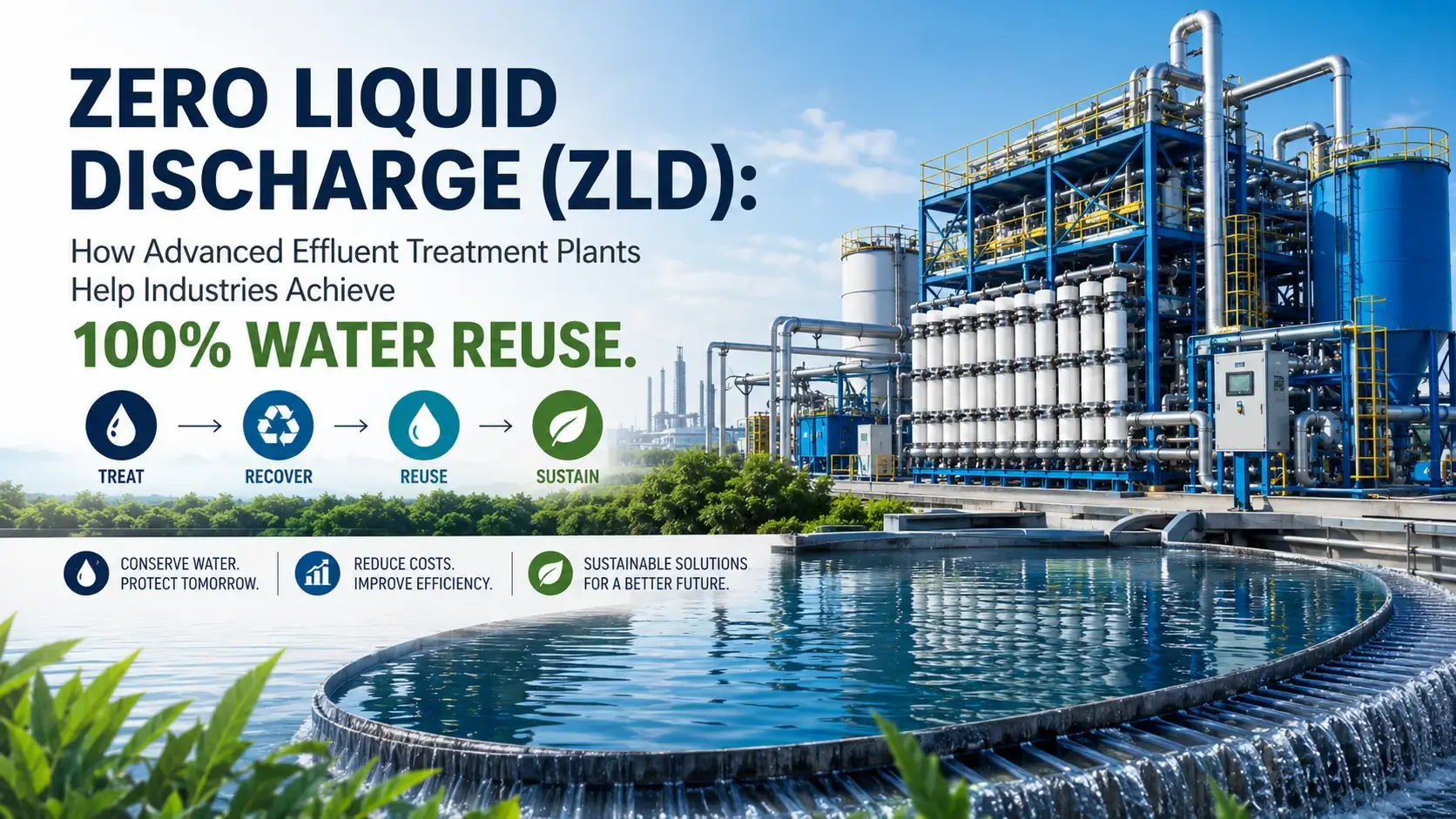
A ZLD plant is designed to recover and reuse almost all the wastewater generated in an industrial process. Instead of releasing treated water outside, the system pushes recovery to its limit.
You end up with:
Reusable process water
Solid waste (salts/sludge)
No liquid leaves your facility. That’s the core of industrial water reuse.
Unlike a standard effluent treatment plant (ETP) that allows discharge within limits, a ZLD system eliminates discharge entirely.
How ZLD Works: Engineering Behind 100% Water Recovery
A ZLD system in India is not a single machine—it’s a carefully engineered chain. Each stage protects the next. If one fails, the whole system becomes inefficient or expensive.
1. Pre-Treatment (Effluent Treatment Plant – ETP)
This is where most plants succeed or fail.
Raw wastewater contains suspended solids, oil, grease, and heavy contaminants. If these are not removed properly, they clog membranes and damage high-cost equipment downstream.
A well-designed effluent treatment plant (ETP) stabilizes flow, removes solids, and balances pH. It creates consistent input quality.
If pre-treatment is weak:
RO membranes foul quickly
Chemical consumption increases
Downtime and maintenance costs rise
2. Biological Treatment
Industries like food processing or pharma produce high organic loads. If this organic matter is not removed, it creates scaling and fouling issues later.
Biological treatment uses microbes to break down these organics, reducing BOD and COD levels.
If this stage underperforms:
RO efficiency drops
Membrane life reduces
System recovery decreases
This is why an advanced effluent treatment plant focuses heavily on process control here.
3. Reverse Osmosis (RO System)
RO is where recovery begins.
High-pressure pumps force water through membranes, separating clean water from dissolved salts. Typically, 60–70% of water is recovered here.
The remaining reject water contains high TDS and cannot be discharged in a ZLD system.
So instead of wasting it, we push it further.
This stage is the backbone of any wastewater recycling plant.
4. Evaporation & Crystallization
This is the final step that closes the loop.
RO reject water is sent to evaporators, where water is separated using heat. The remaining concentrate is further processed in crystallizers to form solid salts.
At this point:
No liquid waste remains
Maximum water recovery is achieved
This is what defines a true advanced effluent treatment plant.
Why Industries Need ZLD
1. Compliance is Non-Negotiable
Pollution control boards are moving towards zero discharge policies, especially for high-impact industries. A ZLD system in India ensures you stay compliant and avoid shutdown risks.
2. Water Scarcity is a Business Threat
When the water supply drops, production suffers. A zero liquid discharge system creates an internal water loop, reducing dependency on external sources.
3. Cost Control Over Time
Water purchase, tanker supply, and penalties add up quickly. With ZLD:
Water costs drop significantly
Risk-related losses are minimized
ZLD Plant Cost in India: Investment vs Reality
Let’s address the biggest concern—cost.
A ZLD plant cost in India depends on:
Plant capacity (KLD)
Type of effluent
Technology selection
Yes, the CAPEX is high. Evaporators and crystallizers are energy-intensive systems, and they increase initial investment.
But look at the bigger picture:
CAPEX (Initial Investment)
High setup cost
Engineering and customization required
OPEX (Operational Cost)
Energy consumption
Chemical usage
Maintenance
Now compare that with:
Water procurement costs
Tanker dependency
Non-compliance penalties
Risk of shutdown
Over time, most industries see ZLD as a cost stabilizer, not just an expense.
Industries Using ZLD Systems (Real Challenges)
Textile Industry
Faces high TDS, color, and chemical load. ZLD removes color and recovers usable water, which is critical for dyeing operations.
Pharmaceutical Industry
Produces complex effluents with variable composition. ZLD ensures safe handling and reuse without regulatory issues.
Chemical Industry
High dissolved solids make discharge difficult. A ZLD plant isolates salts and recovers process water.
Food & Beverage
Organic-rich wastewater requires strong biological treatment before ZLD. Once optimized, water reuse becomes reliable. These industries rely on wastewater treatment solutions for factories that go beyond compliance.
Conclusion: The Shift Towards Industrial Water Reuse
The direction is clear—industries are moving toward closed-loop water systems.
A zero liquid discharge system is no longer just about meeting compliance. It’s about securing your operations against rising water costs, unpredictable supply, and strict regulatory pressure.
Forward-thinking industries are already investing in industrial wastewater treatment with ZLD to:
Secure a reliable water source
Control long-term operational costs
Avoid compliance risks and production disruptions
If you're planning for the next 5–10 years, this is not an upgrade—it’s a necessity.
Partner with HECS for Reliable ZLD Solutions
At HECS (Hubert Enviro Care Systems), we understand that no two industries have the same wastewater challenges. That’s why we don’t offer standard systems—we design solutions that work for your process, your load, and your long-term goals.
With proven experience across textile, pharma, and chemical industries, HECS delivers:
Detailed feasibility studies based on your effluent profile
Efficient and scalable ZLD system design
Reliable performance with long-term operational support
Whether you're planning a new ZLD plant or upgrading your existing effluent treatment plant (ETP), our team works closely with you to ensure maximum water recovery and cost efficiency.
👉 Talk to HECS experts today and get a customized ZLD solution built for your industry.
Share this post: